Writing myself back to childhood in Guayama, Puerto Rico
by Alvilda Sophia Anaya-Alegría
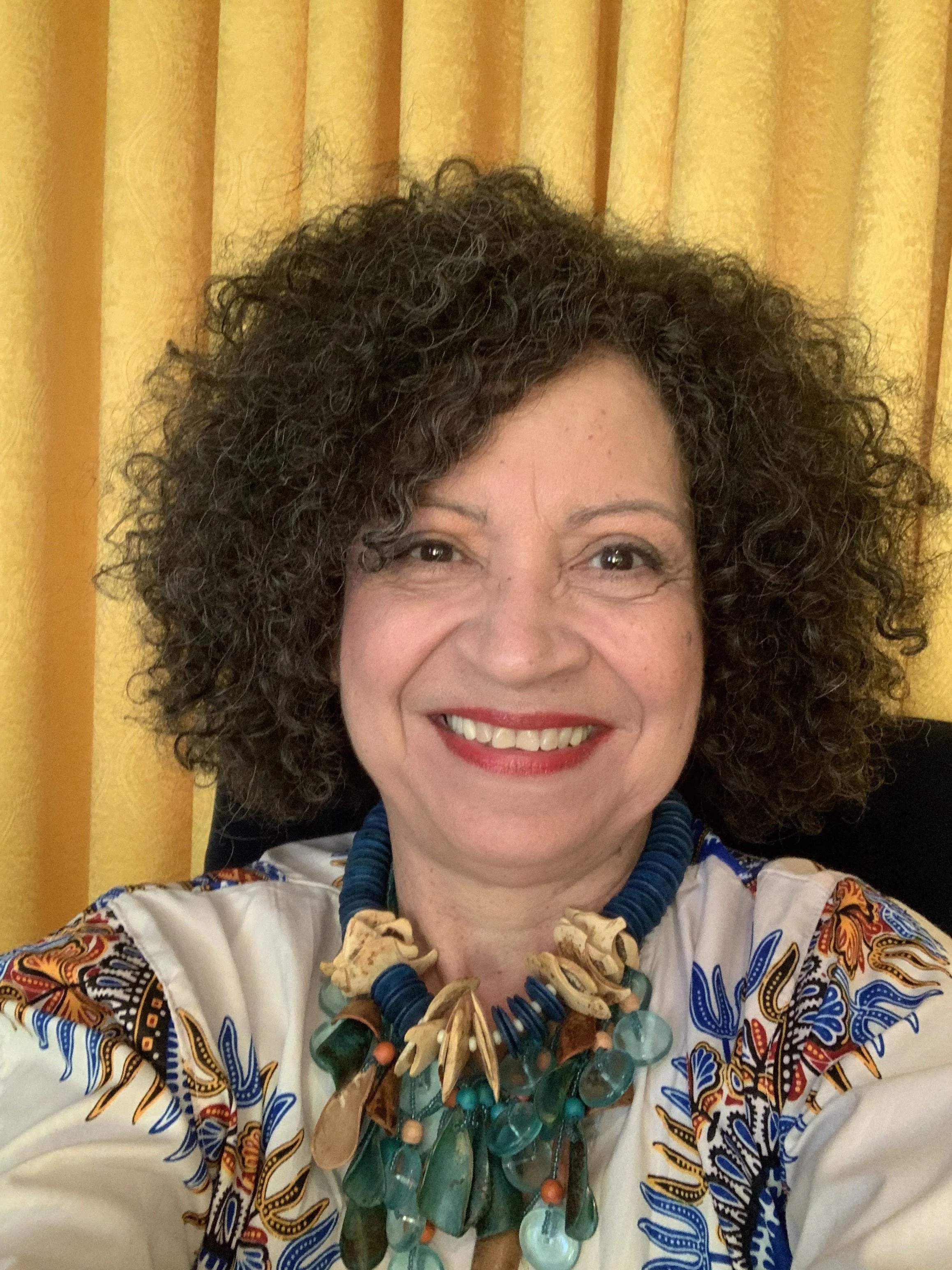
Alvilda Sophia Anaya-Alegría, self-portrait, digital photograph, 2026. Courtesy of the author.
Writing myself back
To Childhood in
Guayama, Puerto Rico
Alvilda Sophia Anaya-Alegría
APR 2026 | Issue 51
Now I know the moment that broke me, but I felt the warmth and sweat on my body when I arrived instead. Now I was in a different landing.
Finally, I thought.
I smelled the sweet ocean but didn’t know what the sweet and salty smells were.
But I wanted to eat them anyway.
An hour later, I could see the sugarcane roaring as its sweet black molasses were taking form.
And my life was also taking form!
El cañaveral y sus surcos ardiendo in flames was mesmerizing. The ocean air a mile away would fuel the fire intensity. The air charged the sky’s colors with reds, blues, oranges and royal purple’s. The heat of the fire and heat of the Caribbean tropics danced in unison and never bothered me. Rather,they were a sweet embrace. They meant home and a secure job, a safe place to live, where I could breathe and listen to the ocean waves.
Although I didn’t understand what any of this atmospheric pressure meant, We—Us—them, always, prayed to the gods that it wouldn’t rain from the school classrooms so that the farmers would not be sent home for a lack of a workload. Harvesting sugarcane lasted only six months of a year, the rest of the year was called tiempo—muerto. If you will, my translation is dead-zone. We would begin counting the money, deducting—against the food, electricity and water bills that we had to pay. We had to pick one or another so we shared with our neighbors, to pay for one thing or another, every two weeks. We would share a long extension to use each other’s electricity, carry water from each other’s home, and share the crops of limones, panas, gandules, lechoza, even some sugar molasses that we could bring home to eat or cook.
Watching tv was a luxury to one or two people in our village so we went without needing electricity for that. We got the first television in Puerto Rico in 1954.
The ashes were part of our currency, food resources, they meant food solace, money to pay la costurera to make our community children’s blue with white stripes uniforms; hence, it was much easier to spend.
At home, we didn’t notice that we didn’t have as much as other people, because my mother Ana Victoria Anaya-Soto made miracles happen. Her struggles during 1968 to 1984 in Guayama, Puerto Rico raising us was paramount. Getting la tela, textile, made our livelihood more joyful. The new textile brought with it happiness and excitement. In that era it meant that we would be taught by la costurera how to cut and sew patterns. We were taught what matched our pale and brown skin tones, curly short hair, dark brown eyes, and pear shaped bodies. And we lived, the warmth, and sweat on our bodies, as we listened to the ocean roar in still contemplation as we grew up on our land.
Alvilda Sophia Anaya-Alegría is a researcher of her Meso-American Indigenous and Taína ancestry traverse the physics of Light and Space-Time quantum mechanics. She is Interested in geometry, geophysics, astronomy, and being surrounded by the La Mar, in Oceanography. As an Economic degree major, from Southern University of New Hampshire, 1986, she follows the colonial mathematical impact of how greed destroys our trees and water resources globally; and the cruelty of the Indigenous killings happening today, throughout the world, and continue to do so in the Amazonia in Brasil to this day, to extrapolate these goods. The perpetrators are North American white man owners of Wall Street. Alvilda is a published writer and professional fine art painter and Installation Artist and Urban Artists in the States, Mexico, Dominican Republic and Puerto Rico. She has been a scholar professor at Springfield College and Instructor at UMass Amherst, MA. A Puerto Rican interdisciplinary artist, memoirist, and urban muralist painter, she loves to research history and unpack the America Latino and Caribbean heritage with a multi-matrix approach to dismantle the public’s economic system. Alvilda lives in Springfield, Massachusetts.