Northern Waters
by Cristina Olivetti
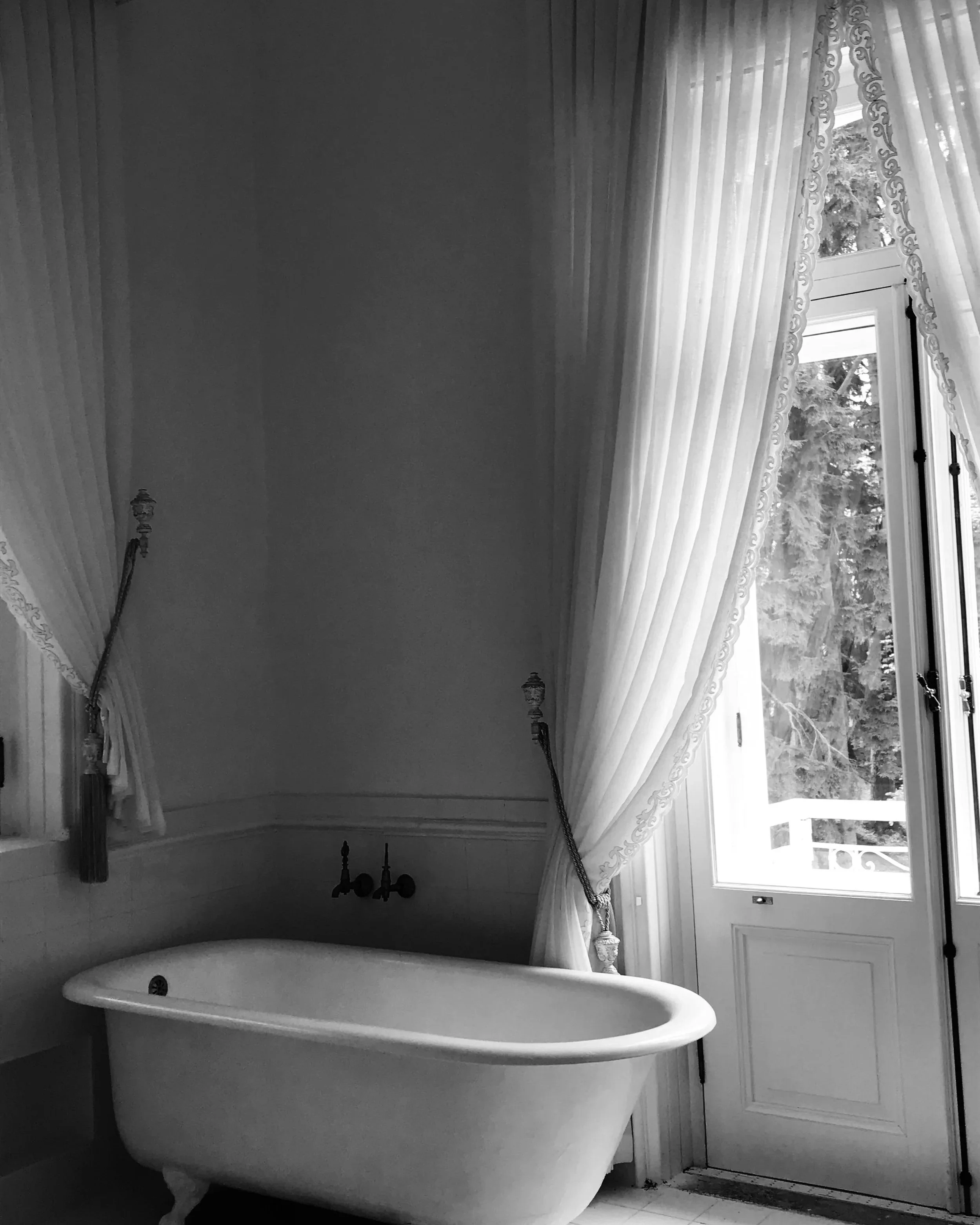
muhammet celebi, Untitled, digital photograph, 2023. Courtesy of the artist.
Northern Waters
Cristina Olivetti | APR 2026 | Issue 51
I slipped into the tub and pressed myself against the white porcelain. Every inch of me up to my chin submerged. My skin was hot velvet under my palm and pulled my hands along my inner curves, around the friendly dough of my too-soft abs, under the weight of my breasts. I inhaled the steam, then let my arms go limp, felt the fullness of my lungs float me toward the surface. The cold air tickled my nipples when they rose above the waterline. I exhaled and sunk back below the water, my skin tingled. Then I pinched myself (oh my nipples, the milk they have let down, the pleasure they have given me) and felt the familiar thought-stopping zing buzz between my legs. The tub had an old faucet shaped like a telephone receiver. I turned it on and ran the warm water over my head and shoulders then dragged the current between my legs.
It was high summer. I had arrived in Dublin that morning alone on my second international on my own since my husband became sick five years ago. Window boxes full of red and purple petunias, trailing lobelia and bleeding heart fuschia hung from sills of limestone buildings. Students packed the sidewalks and cobblestone streets outside of pubs. A long line of tourists waited online to enter a theater to see Riverdance. But instead of strolling the city, I checked into my hotel room and drew a bath.
My husband has a neurodegenerative disease and has been paralyzed from head to toe for a few years now. He can still have sex, theoretically. We have tried, at least.
It was serious bad luck for him, for us, really, that right when he got sick I found myself in the throes of perimenopause. The sparks I used to feel between my legs when I sheered myself against him went out. And no matter what angle I tried, I couldn’t strike that sizzle. I didn’t bother telling him that my orgasm had disappeared. How can you tell a guy who is in the middle of losing everything that your orgasm has disappeared?
He adores me. His mind is still sharp. He would have wanted to know.
Instead, I got on top of him and I tried. I went through the motions with limited success for him. I feared hurting him. Once he stopped in the middle of my firestarting because his skin was stinging—I think his helper was washing his crotch with more than just water. My husband has exquisitely sensitive skin, which in the past had been a real source of delight, but now was a problem. Another time my chest was so heavy on his chest his weakened lungs could not breathe in. My beloved of twenty-five years could do the deed, but the pressure to pleasure both of us was more than I could handle, a force that broke both of our hearts beyond recovery.
A part of me felt there was some basic justice coming to bear in the relationship the two of us share with his illness. Sex that is a one-way street is a transaction, not a relationship. And when we took our vows all those years ago it was to be in a relationship, a partnership. We could not have imagined that “in sickness” might mean one of us would become dependent in the prime of our lives. On bad days, there is a voice inside my head that berates me for withholding the one pleasure left to him that I could be offering. I wanted to be that kind of wife, a woman of unlimited generosity and love, but it turns out, I’m not that woman.
+
By the time I got to Dublin, I had been taking refuge in bathtubs for years. A brutal beauty of my life is that sex alone in the tub has turned out to be some of the most pleasurable sex of my life.
In the beginning of the illness, even though I had three children to live for, I wanted to die with my husband. I look at pictures of myself from that time—my skin is gray, my hair is limp, I am as heavy and inert as I have ever been. I taped a hot pink sticky note on my bathroom mirror that said, “Death is a part of life. You have to live,” a reminder that my main to-do everyday was to keep in mind that my body belonged more to the living members of my family than the dying member. Sinking myself into my bath tub was one of the only activities that I could do on the worst days. I think all that warm water melted the part of me that had become inert with wanting to die with my husband.
With only myself to worry about in the tub, my orgasms became otherworldly even with all the ups and downs of hormone changes. Or maybe because of them. I’d stare through the window at the hundred-year-old redwood just outside my window at home and I’d have the sudden urge to fuck it, fuck the tree, ride the peak of its crown my legs dangling around its trunk, the needled branches embracing my white nakedness. I’d hear a fragment of birdsong and wonder how to fuck a sound. And there was the less absurd genre of fantasy. The blue eyes of my college lover flashing me, unbuttoning the blouse with the pink flowers I wore near daily that fall of my first year of college.
This private revival made me feel like a teenage boy at Catholic summer camp. A wild inappropriateness had me in its grips, setting me on fire between extended hospital stays, grave conversations with doctors, negotiations for expensive rare medicines from insurance, and the monthly spinal taps my husband endured. But no matter how guilty I felt about this, I noticed my death wish was gone, which seemed like an overall plus for the family.
I became a magician with the tub faucet. I bought a new vibrator. A few times a week I disappeared into my tub and answered to no one. After I came in the tub on that trip to Dublin. I sunk my head under the water and stayed for a while. Sunk like that, relaxed after coming alone. I almost felt free.
I have come to think of my own pleasure as the private effort I put in for the good of the family. On bad days, the crueler voice inside suggests that this perspective is just a way to quiet my shame for allowing myself pleasure at all.
+
The light of that first night in Dublin stretched out late, as it does in the British isles in summer. I walked through St. Stephens Green and ended up in an old Victorian neighborhood. Vintage stores peppered the lane. I zigged and zagged into one and then another forcing myself to fight the jet lag. One store had a collection of antique pearls. I thought of Seamus Heany’s famous line about oysters, “My palate is hung with starlight,” when I saw their sheen in the display case. I bought three strands: two for my daughters and one for my best friend Laurel. I imagined clasping them around each of their necks to wear at my husband’s eventual funeral. I keep the pearls in my lingerie drawer in California and I look at them sometimes just to make sure they are still there.
The National Museum of Ireland was not originally on my itinerary, but it was recommended to me by an old friend. I’m generally not a fan of warfare or the equipment of warfare—the chainmail, the swords, the idea of gangs of men fighting over land and people they feel entitled to own. I’m really over that. But, in this museum, past all those usual historic artifacts, is a square room where the lights are dimmed. It’s a cavern with brown walls, a central hallway, and spirals of walkways that eddy into each of the four corners of the space. Like walking into the catacombs in Rome or into the damp cold of St. Patrick’s Cathedral, the space commands reverence. At the terminus of each spiral path is a display case containing a shrunken human body brown as wood chips, deflated leather balloon bodies. These are Ireland’s bog people.
Most bog bodies came to violent ends sometime in the Iron Age (700-200 BC) and are found at the boundaries of ancient tribal territories. The acidic, oxygen-poor environment of peat bogs “tanned” their skin and preserved their human form. They are missing heads, missing limbs, gashed across the mid section, but their fingernails, hair, and skin are all eerily, horrifically intact. Some were found adorned with gold collars and rings and accompanied by urns of ancient butter—signaling to historians that these weren’t just any murders, but killings used to mark borders, protect kings, and reify community cohesion. Some are believed to be ritual sacrifices meant to protect the power of tribal kings. And in 2023 a new female body, believed to be a ritual sacrifice, was found in Northern Ireland. She is known as The Ballymacombs More Woman.
A woman in Iron Age Ireland had more rights than you might expect. She could own land, she could serve as head of household if she brought more land to the marriage than her husband, she could divorce a man who was abusive, unfaithful, or who was too fat to perform his marital duties. But none of this exempted her from her spiritual role in the sacred kingship rituals of the time. The ancient kings of Ireland were considered married to the land and if the community fell into famine, if the land produced a poor harvest, or if a plague spread among their cattle, it was believed that the king’s sacred contract had been broken. To restore balance, a high value offering, for example a high status woman, was presented as a sacrifice to the gods to plead for the survival of the community. The Ballymacombs More Woman is thought to have been killed in this kind of sacrifice. She was between 17 and 22 years old, and was 5’6”, which is not such an unusual detail, but happens to be my height.
I want to say the bog bodies are life-like, but that phrase implies fictional bodies, as if the bog people are renderings. They are life-like because they are dead, not alive. This is not how we usually use this phrase. But here, in the National Museum of Ireland, in Dublin, these dead bodies are not just life-like, they are truly life itself. The death chapter. The one we don’t usually see and we don’t care to look at.
Of all the things I see in Ireland. This is the image that repeats. The hair and the fingernails and the skin of these bog people, especially the woman. There is the porcelain bathtub in my hotel room. Then the bog woman. The aqua water of Dog Bay. Then the bog woman. The starlight sheen of old pearls. Then the bog woman. The lush leaves of beech trees, window boxes full of petunias and lobelia and bleeding heart fuschia. Then the bog woman.
+
In the second half of my drip I drove up to Connemara and stayed at a manor house in a small town called Letterfrack. Set up on a hill overlooking Ballinakill Bay on one side, nestled into a small stretch of forest on the other, the inn had been run by the same family for at least two generations. When I arrived in the afternoon my stomach was rumbling. I asked if they served snacks at the bar. A young French woman told me the kitchen was closed. I asked if there was anything left over from breakfast, maybe a scone. She went back to look. She returned with a pot of English Breakfast tea, two warm scones, butter, jam, and clotted cream. It was more than I had dared imagine. I sat at a small table and smeared butter, then jam. I dolloped the top with cream. I closed my eyes and let a bite spread on my tongue. The scone was tender between my teeth, warm and easy and sweet. I could taste the care of the hands that had cut the butter into the flour and poured cream and forked then rolled out the dough. I sank into the seat. Leaned back. Sipped tea. I breathed long and deep between tastes.
The next morning I woke up early and drove by the entrance to Connemara National Park. I had considered hiking, but I wanted to see the ocean.
I drove along the coast through Roundstone and parked in a crowded lot at Dog Bay. The inn keeper had suggested that instead of stopping at the first beach I saw, to climb over the dune, to the far side of the spit of land that reached out into the Atlantic.
Sand as white as sugar spilled on either side of the rise. The water lapped along the shore aqua blue like I had seen when I was a girl on a family vacation in the Caribbean, even though I was as far north as I had ever been in my life. The sand shifted beneath my feet and the wind whipped across the beach lifting up just enough sand to bite at my ankles. I leaned against a boulder the size of a VW bug for balance as I slipped out of my sweatshirt and leggings. I stood in my swim suit facing the bay for a brief moment. I tasted the salt of the sea in the air. Goosebumps rose on my skin. Then I walked into the bay.
The coldwater shock made me catch my breath. My red toenails blinked from below the surface. I cut my thighs hard through the sea until I was deep enough to go under. I put my fingers to my nose to hold my breath and plunged. The cold kept coming, numbing my calves and biceps and glutes. I stayed under as long as I could.
When my head popped up I looked to the horizon. My bones ached from the cold. My flesh had all but disappeared into numb. Salt water stung my eyes. I knew my body was never going to get used to water this cold, and still, I did not want to get out. Graham’s limp body and the tanned corpse of the bog were still there, haunting me the way they do. But the cold water owned me right then. Those Northern waters forced sharp deep breaths into my lungs, jacked my heart into my throat, made my bones groan with sensation. I was in pain, yes, but I was alive.
Cristina Olivetti is a writer from Northern California. Her memoir, About Bliss: Fighting for My Trans Son’s Life, Joy and Fertility was published in June 2025 by Jessica Kingsley Publishers, an imprint of Hachette Book group. Her works in progress include a longform meditation on marriage and mortality, currently titled No One Dies in the End and other Truish Lies I Tell, as well as a translation of Lettere Americane, a series of letters written by Camillo Olivetti, the founder of Olivetti typewriters, in 1894 while on a trip to the US to attend the World’s Fair in Chicago. She is the primary caregiver for her husband of twenty-five years who was diagnosed with ALS in 2020.