Five Cents a Box (Aurora’s Resolve)
by Christina McPhee
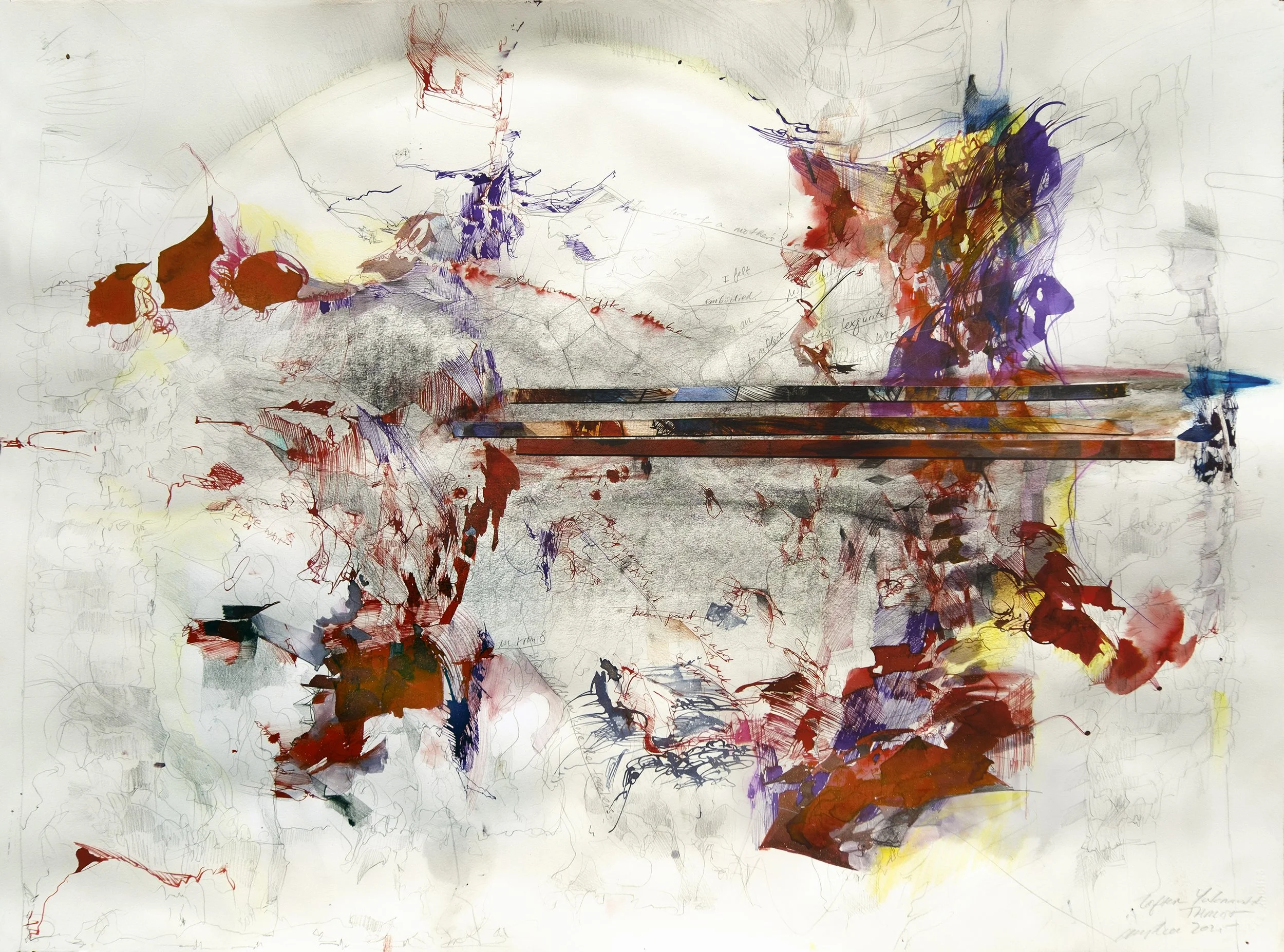
Christina McPhee, Five Cents A Box (Aurora's Resolve), watercolor, ink, and collage on Arches hot press paper, 22.25 x 30 inches, 2025. Courtesy of the artist.
Five Cents a Box (Aurora’s Resolve)
Christina McPhee | JAN 2026 | Issue 50
“A boy named Hiram, who’d been paid five cents a box to pack sardine cans, though he could manage only four boxes a day. Before being sent to the cannery, he’d worked full nights at a spinning factory, he was so young and small that he had to clamber up the sides of the spinning frames to work the threads and bobbins, and he’d lost most of one foot in the process.” — Lidia Yuknavitch, Thrust, 2022
One August night on Vancouver Island, in 2022, my daughter and I watched the aurora borealis. Or was it that? It looked like a celestial caravan of stars moving in concert, in an arc from ten degrees above the conifers to thirty: not brilliantly colored, but diamond, in strings! what could it be?
Lidia’s Aurora dominates desire and the arts in Thrust, and is always moving away at light speed from any form of capture. Like the borealis she is evanescence itself, apparently, but something about her compels my loyalty and attention, good dominatrix that she is. Various efforts to draw it out from the matrix of Aurora came in fits and starts through the next three years: she was still on my mind. For this drawing I was moved by the stories of the children Aurora sequesters in a secret classroom behind locked doors, not to entrap, but to save them from being taken and sold into slavery even worse than their previous conditions. Here was where Aurora stops moving endlessly away into the night sky like some temporary constellation. Here was where Aurora is burning bright…it’s because the key to everything about her power is her service to these children.
I looked up from my drawing table and saw, again, my stack of watercolor strips: these remnants I’d cut to perfect lengths from the paper stock of oversaturated and brutalized mark making, making a rudimentary archive of bandage-like stick-forms, like splints. Suddenly I remember: Aurora has an artificial leg, which Yuknavitch dreams up as a sculpture, custom-made like a Frida Kahlo prosthetic, by the artist of the Statue of Liberty. I lay them out and glue them down, like scaffolding, or better, like a binding of wounds over the scrawling letters, my handwritten transcript from Aurora’s clinic, where her implied voice lets slip the tale of Hiram’s plight.
Christina McPhee is a visual and media artist. Her work is a place and a performance within a matrix of drawing, electronic media, and painting, wherein graphical scores for music, literary and textual translation, montage and collage of scientific visualization converge. Art histories of landscape painting in a global context, from Japanese nihonga to eighteenth and nineteenth century veduta and rococo sketches, are core resources in her work. Multiplicity, doubling, shattering, erasure, shadowing, and pentimenti characterize the drawn effects of this research. Many of her works, from the nineties until now, have engaged the post-colonial American western landscape as an abstraction which derives from what she describes as seismic memory, intimating a cybernetic feedback between the earth's telluric forces and human trauma. Recent drawings and paintings engage with theatricality and performance, with more-than-human comedic animations drawn from the stories of popular saints and mythic creatures, from Saint Francis to Melusine. Yet the ambient mood of displacement and reflective meditation also manifests through her use of low relief effects in new paintings that adumbrate hyper-objective conditions of life, things that cannot be directly seen, into newly recaptured and nascent visual fields. These objects carry an intense presence or quality of embodiment because of the strong presence of hand-work via almost hyper-vigilant, hypnotic drawing. Thresholds are constant on the verge of reach. Shifting moire effects in ink recall tapestry and intense craft. She uses the neologism 'naxsmash' to indicate a poetics of simultaneous birthing and fragmentation across the body in drawing, painting, photomontage, and video. She has collaborated with field scientists, composers and musicians in live and recorded works for performance since 2005. Her writings in new media theory and culture as well as occasional criticism are extensions of her intense engagement with, and commitment to ways of working in fugue-like topologic structures of thought and material. Born in Los Angeles, she grew up on the Great Plains, and later earned the BFA in painting and printmaking from Kansas City Art Institute, and the MFA in painting from Boston University. Her work across media in drawing, painting, video, and electronic media works are held in museum and public collections, among them the Whitney Museum of American Art, International Center of Photography, and the Kemper Museum of Contemporary Art, among others. She lives and works on unceded traditional lands of the northern YTT Chumash and Salinan tribes in what is now central coast California.